

After RNDC, Has the Risk Equation Changed for Emerging Brands?
By John Beaudette | Beaudette Beverage Group
I’ve obviously been following the RNDC bankruptcy closely, as I suspect most people in the beverage alcohol industry have.
There has been a tremendous amount written about what happened, why it happened and who may have been responsible. Some of the commentary has become pretty heated.
I don’t have access to all the facts, and I’m not particularly interested in adding to the speculation. We will learn a lot more as the bankruptcy process moves forward.
I also don’t want to lose sight of the fact that there are a lot of people and businesses being affected by what happened.
Thousands of employees worked for RNDC. Suppliers, including many smaller brands, depended on the company to get their products to market. Vendors and service providers did business with RNDC. Some of these companies may be owed money, some have had to find new routes to market, and others may be dealing with disruptions we don’t even know about yet.
For a large company, a significant setback can be painful. For a small emerging brand that is already operating with limited capital, a much smaller disruption can sometimes threaten the business.
I think that deserves some recognition as we discuss what happened.
But the RNDC situation has also caused me to think about a broader question. I’ve spent decades working with beverage alcohol companies, much of that time with smaller and emerging brands. The environment for those brands today is about as difficult as I can remember.
RNDC certainly didn’t cause that. Most of these challenges were already here. But what happened at RNDC is another reason to look at how much the industry has changed and what that means for someone launching, investing in or valuing an emerging beverage alcohol brand today.
Building a Brand Has Gotten Harder
Building a successful spirits or wine brand was never easy. We sometimes forget that when we look back at the brands that became enormously successful.
For every Casamigos or Tito’s, there are hundreds, probably thousands if you go back fifteen years, that never achieved their original goals and vision, including many that failed completely.
But there was a period when the path seemed somewhat clearer. Develop a good product and story, raise capital, get distribution, build cases and hopefully attract additional investors and eventually a strategic buyer.
It was never that simple, but the environment helped.
Spirits were growing. Capital was readily available. Distributors were adding brands. Strategic buyers were active. And some of the acquisition multiples being paid were extraordinary.
Today we have almost the opposite situation in several respects.
Overall alcohol consumption is under pressure. Spirits volumes have declined. There are probably more brands chasing distributor and retailer attention than ever before. Raising capital has become much more difficult, particularly for a brand that hasn’t already demonstrated meaningful traction.
And getting a distributor appointment doesn’t mean what some entrepreneurs think it means.
I’ve seen this repeatedly over the years. A brand owner gets appointed by a major distributor and understandably views it as a major accomplishment. It is.
But six months later, the more important question is: What happened after the appointment?
How many accounts are buying the product? Are they reordering? Are depletions growing? Is the distributor carrying too much inventory? How much is the supplier spending to generate those sales?
Getting distribution is important. Getting productive distribution is what really matters.
I’ve also heard the suggestion that one lesson from RNDC may be for suppliers to spread their business among more distributors. I’m not sure it’s that simple. I remember the consolidation of the wholesale tier in the 1980s and early 1990s. There were more than 1,600 licensed wine and spirits distributors in the U.S. in 1984, many carrying the same spirit brands in the same markets; by 2002 there were fewer than 600 spirit players. Some failed, others were sold or combined, and suppliers increasingly consolidated important brands with the wholesalers they believed could best support them. Major wholesalers today may also seek broader geographic relationships with brands they really want. Diversification can reduce some risks, but I think the financial strength of the distributor, its commitment to the brand and the quality of the relationship may ultimately matter more than simply how many distributors a supplier has.
And today’s environment gives smaller companies less room for error.
A large supplier has the financial resources, people and portfolio to absorb setbacks. An emerging brand doesn’t need a $90 million problem to find itself in serious difficulty.
Losing distribution in an important market, carrying too much inventory, having a rollout delayed or suddenly needing another million dollars of capital can completely change the trajectory of a young company.
That has to be part of the risk equation today.

RTDs Tell an Interesting Story
RTDs are probably the best example of how complicated the current market has become.
The growth has been remarkable. Spirits-based RTDs have grown several times over since 2020 and are now a very significant part of the U.S. spirits business.
But what I find equally interesting is where much of that growth is occurring.
A relatively small group of very large RTD brands represents a substantial majority of category volume. Many are backed by companies with enormous distribution, marketing and financial resources.
So yes, the category is growing. But that doesn’t necessarily mean every new entrant participates equally in that growth.
I’ve seen enough business plans over the years to know how easy it is to take an attractive category growth rate, assume a new brand can capture a very small percentage of it and arrive at a very large future business. The math works. Getting to the consumer and getting the consumer to buy the product is the hard part.

What Does This Mean for Valuations?
This is where I think the conversation gets particularly interesting.
I’ve been involved with beverage alcohol brands and transactions for many years, and I spend a fair amount of time today thinking about brand valuations.
One thing I have become increasingly convinced of is that two brands with exactly the same revenue can have very different values.
Take two spirits brands each doing $5 million in annual revenue.
One is growing depletions at a healthy rate, has good retail velocity, reasonable inventory levels, attractive margins, repeat consumer demand and enough capital to continue executing its plan.
The other is also doing $5 million, but sales have flattened, distributor inventories are high, the company is spending heavily to support the revenue and another capital raise is going to be needed shortly.
I don’t think anyone who understands this industry would value those businesses the same way.
Yet we still hear a lot of valuation discussions that begin and sometimes end with, “What multiple of revenue are brands getting?”
Revenue matters. Case volume matters.
But I think the quality and sustainability of that revenue matter more today than they did when the overall industry was growing strongly and capital was easier to obtain.

We Need to Be Careful With Comparables
I’ve seen this many times.
A brand owner reads that another tequila, whiskey or vodka brand was acquired for some very large number. They estimate that company’s case volume or revenue, calculate a multiple and apply it to their own company.
I understand why.
Comparable transactions are an important part of valuing a beverage alcohol company, particularly because many emerging brands aren’t profitable and traditional EBITDA or discounted cash flow approaches don’t always tell us very much.
But the comparable has to actually be comparable.
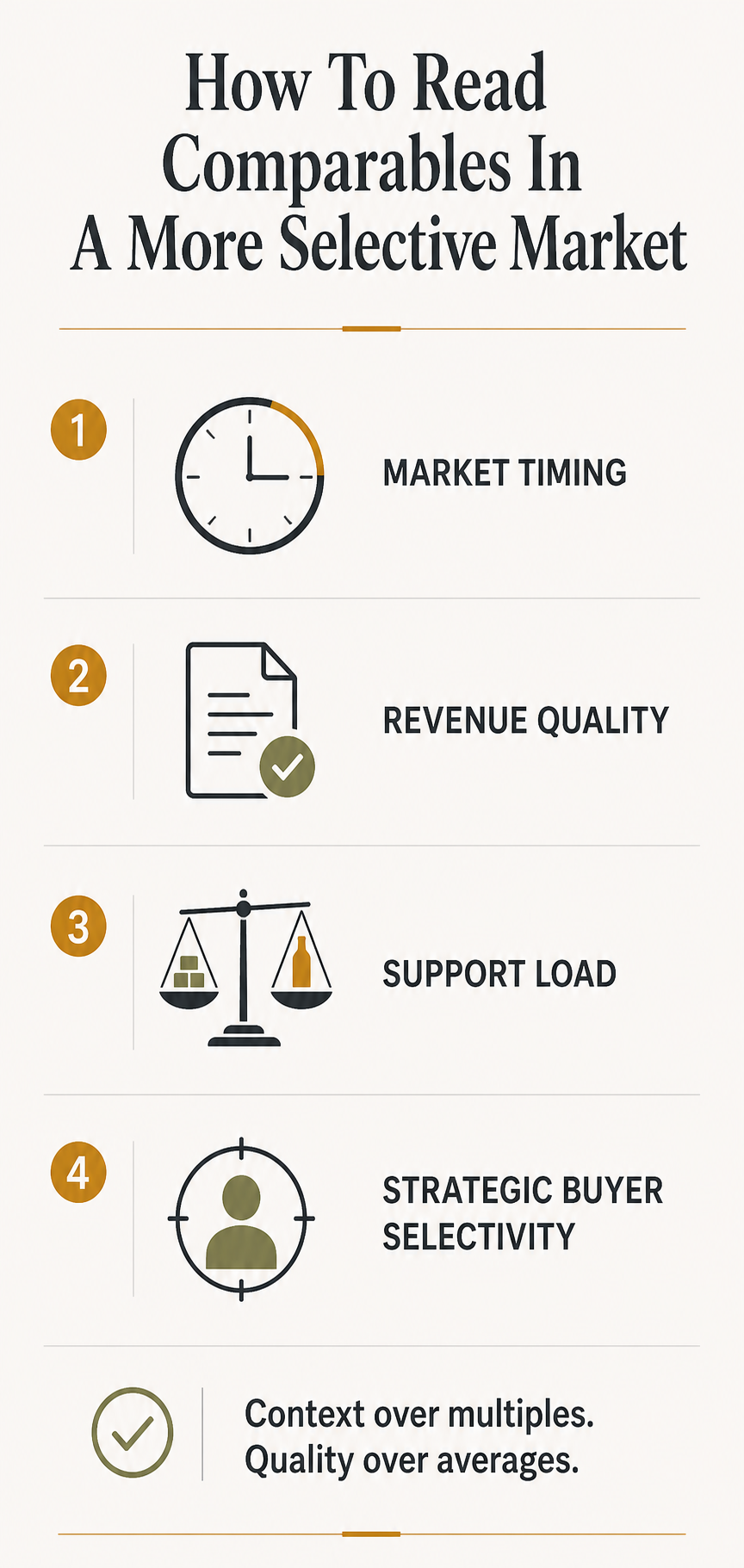
When was the transaction? Was the category growing rapidly? How fast was the brand growing? Was there competitive bidding? Was a strategic buyer filling a particular hole in its portfolio? What were the margins? How much additional investment was required?
And perhaps most importantly today: what did the acquisition market look like at the time?
A multiple paid during a very different industry environment shouldn’t automatically become today’s multiple.
Historical transactions remain useful. They just need context.
The Buyers Have Changed Too
This is another part of today’s valuation environment that I think is important.
Many of the large global beverage alcohol companies are spending a lot of time looking inward right now. That’s understandable.
They are dealing with slower industry growth, changing consumer behavior, pressure on margins, changing category preferences and, in some cases, significant organizational restructuring.
Diageo is a good current example.
Its new CEO, Sir Dave Lewis, has laid out a significant multi-year program aimed at reducing costs, improving competitiveness and reinvesting behind areas where the company believes it can generate growth. Diageo has also acknowledged continued weakness in North America and is now projecting only low-single-digit organic sales growth over the next several years.
That’s a very different environment from one in which the large strategic companies are aggressively competing to acquire the next high-growth emerging brand.
I’ve heard similar thinking around other large players.
That obviously matters to valuations today. If fewer strategic buyers are actively looking, or if they are being considerably more selective, there is less competition for emerging assets.
But I don’t think this is permanent.
In fact, this is one of the reasons I remain optimistic.
The large global companies are going to spend the next several years adjusting their businesses to the new environment. They’ll reduce costs, rationalize portfolios, decide where they want to compete and hopefully return to stronger growth.
At some point, they’re going to need growth again.
And I don’t believe they will be able to create all of it internally.
My guess is that acquisitions will become an important part of the strategy again.
If I’m right, the brands that make it through this difficult period could find themselves in a very interesting position.
Think about a brand that continues growing over the next two or three years despite softer overall consumption, limited access to capital, difficult distribution and intense competition for retailer attention.
That tells you something.
If that brand comes out the other side with meaningful consumer demand, good margins, strong depletions and a healthy business just as strategic buyers begin looking externally for growth again, I suspect there will be considerable interest.
In some ways, today’s difficult market may actually be doing part of the screening for them.
The brands that can thrive in this environment may turn out to be exactly the brands the large companies want when acquisition activity returns.
Potential Value and Today’s Value Aren’t the Same Thing
Entrepreneurs have to be optimistic. Nobody would go through the time, expense and frustration of building a beverage alcohol brand if they didn’t believe it could become something significant.
And some of them will be right. I still believe new spirits, wine and RTD brands being created today will become enormously valuable companies.
But there is a difference between what a brand could ultimately be worth and what it is worth today.
There may be a great product, beautiful packaging, a compelling founder story and a very large addressable market.
But somebody still has to get from here to there.
How much capital will that take? How difficult will distribution be? How much consumer trial needs to be generated? How long will it take? And what are the chances the company actually gets there?
Those questions have always mattered. In today’s environment, I think they matter considerably more.
Where Does RNDC Fit Into This?
I wouldn’t draw a straight line from RNDC’s bankruptcy to lower brand valuations. That would be much too simplistic.
RNDC didn’t create declining alcohol consumption. It didn’t create the difficult capital markets. It didn’t create SKU proliferation or the competition for retailer attention.
But it is another very visible indication that this industry is going through a period of significant change.
And unfortunately, there are suppliers, employees, vendors and others who are dealing with the consequences of that change right now.
I hope the industry doesn’t lose sight of them while everyone debates what went wrong.
For someone thinking about launching a brand, none of this means don’t do it.
For someone considering investing in an emerging brand, it doesn’t mean there aren’t great opportunities.
And for an existing brand owner, it certainly doesn’t mean the business is worth less simply because the market has become more difficult.
What it does mean, in my view, is that we need to be more realistic about risk.
Distribution matters, but the quality of the distribution matters more.
Revenue matters, but the quality of the revenue matters more.
Category growth matters, but you need to understand who is actually capturing that growth.
Historical transaction multiples matter, but only in the right context.
And future potential absolutely matters. But it has to be weighed against what it will take, and what it will cost to actually achieve it.
After decades in this business, I remain optimistic about the beverage alcohol industry and particularly about entrepreneurs who find a real point of difference and create genuine consumer demand.
I think the bar is higher today. But for the brands that clear it, that may ultimately prove to be a very good thing.
When it comes to valuation, perhaps the most important question isn’t simply: “What could this brand eventually be worth?” It may be: “What has to happen to get there, how much will it cost, and how likely is it to happen?”